March 18
Coffee on an empty stomach? Your hormonal system says no – This is how coffee affects you
0 comments

March 18
0 comments
The first grasp in the morning at the coffee mug – a ritual that is sacred for many of us. But what feels like the perfect start to the day could harm your body more than help it in the long run. Let’s take a closer look at why this morning habit unnecessarily stresses your hormonal system.
I’ll explain to you, without complicated jargon, what really happens in your body when the first thing you get in the morning is a dose of caffeine.

Imagine your body is just slowly waking up. Your hormonal system is still gearing up for the day and getting everything running. If you drink a coffee right away, you’re giving your system an unnecessary electric shock. The caffeine triggers a sudden surge of the stress hormone Cortisol.
This process suddenly puts your body into an artificial “fight-or-flight” mode, even though there is no real danger. Instead of waking you up gently, you’re hitting the panic button right after getting up. Imagine you are sitting relaxed on the sofa and suddenly someone jumps out from behind the curtain and yells “Boo!”. That’s exactly what you do to your body every morning.
Your morning coffee should support you, not stress you out further. Drinking it on an empty stomach is like a false alarm for your entire system.
Over time, this daily stress can throw your blood sugar levels out of whack and lead to the dreaded energy lows in the afternoon. But don’t worry: Even a small adjustment to your morning routine can make a huge difference for your energy and well-being.
Sometimes coffee is also deliberately consumed while fasting, but caution is required here as well. If you’re interested in this topic, check out our article on the Intermittent Fasting Diet. There, we show you how small changes can have a big impact without having to give up your beloved coffee.
Imagine your hormonal system as a perfectly tuned orchestra. Each hormone is a musician who knows exactly when it’s time to play their part, creating the symphony that keeps you energized and focused throughout the day. The conductor of this morning concert is the hormone Cortisol.
Cortisol is your very own built-in alarm clock. Your body releases it naturally after waking to get you going. This level rises slowly, typically peaking between 8 and 9 AM. This is a completely healthy and important process that’s part of your biorhythm. If you want to dive deeper into this topic, check out our article about the circadian rhythm and how to optimize your health.
And now coffee comes into play. If you drink coffee exactly during this time window when your cortisol level is already at its peak, it’s like you’re drowning out the entire orchestra with a loud trumpet. The coffee artificially spikes the cortisol peak even further, putting your system into an unnecessary state of alarm.
Caffeine on an empty stomach acts like an accelerant for your body’s stress response. Instead of being gently awakened, it catapults you straight into ‘fight-or-flight’ mode. The result? Inner unrest, nervousness, or even a racing heart are often the consequences.
The tricky part: Over time, your body gets used to this artificially induced stress. Your natural cortisol production dulls. This results in you feeling even more tired and lethargic without your morning coffee. You develop a dependency just to feel ‘normal’ again.
Coffee on an empty stomach sabotages your body’s fine timing. It increases stress instead of gently giving you energy.
But cortisol isn’t the only musician that goes out of sync. The caffeine kick also provides an extra dose of Adrenaline, another stress hormone. Your heart beats faster, blood pressure rises – your whole body prepares for a danger that isn’t even there.
The following table shows the hormonal effects again in direct comparison:
A direct comparison of the effects of coffee on an empty stomach versus coffee after a meal.
| Hormone | Effect with coffee on an empty stomach | Effect with coffee after a meal |
|---|---|---|
| Cortisol | Strong, excessive release; can dull the natural response in the long run. | Moderate, gentler stimulation; the natural cortisol curve is not so strongly disturbed. |
| Adrenaline | Significantly increased output; promotes ‘fight-or-flight’ response (nervousness, heart racing). | Lower adrenaline output; less abrupt rise in pulse and blood pressure. |
| Insulin | Higher blood sugar response after breakfast; can contribute to insulin resistance. | Stabilized blood sugar levels; food buffers the caffeine effect on the cells. |
As you can see, it makes a significant difference whether your body already has a foundation to work with. A small meal can significantly soften the sharp edges of the caffeine kick.
The impact on your blood sugar levels can be even more dramatic. This is especially a topic in Switzerland, where we consume around 1000 cups per person per year, ranking among the world leaders in coffee consumption. A well-known study has shown that coffee before breakfast can cause blood sugar levels to spike after the meal by up to 50 %.
Why is that? Caffeine impairs your cells’ ability to effectively absorb sugar from the blood. This forces your pancreas into overtime and heavily stresses your hormonal system in the long run. You can find fascinating insights on this topic here at the Swiss Illustrated.
Coffee on an empty stomach can send your blood sugar levels on a wild roller coaster ride. Imagine hitting the gas pedal without a full tank – that’s exactly what happens in your body.
Caffeine can temporarily block your cells’ ability to take up sugar from the blood. Normally, your cells would absorb the sugar like a sponge to generate energy. However, caffeine essentially puts a thin protective layer over these sponges.
When your stomach is empty, this effect is particularly strong. Your body responds to the caffeine, releases stress hormones, and as a result, sugar enters the blood – but the cells cannot utilize it properly.
The result? A rapid spike in blood sugar, followed by an equally quick crash. At first, you might feel awake and full of energy, but shortly after, the pendulum swings in the opposite direction.
This crash is exactly what causes the dreaded afternoon slump. Suddenly, you feel tired, unfocused, and have an uncontrollable craving for something sweet. Your body is practically screaming for quick energy to compensate for the deep drop in blood sugar.
A stable blood sugar level is the key to consistent energy throughout the day. And the first meal lays the foundation for that.
The following graphic illustrates how much the blood sugar can spike when you drink your coffee before breakfast.
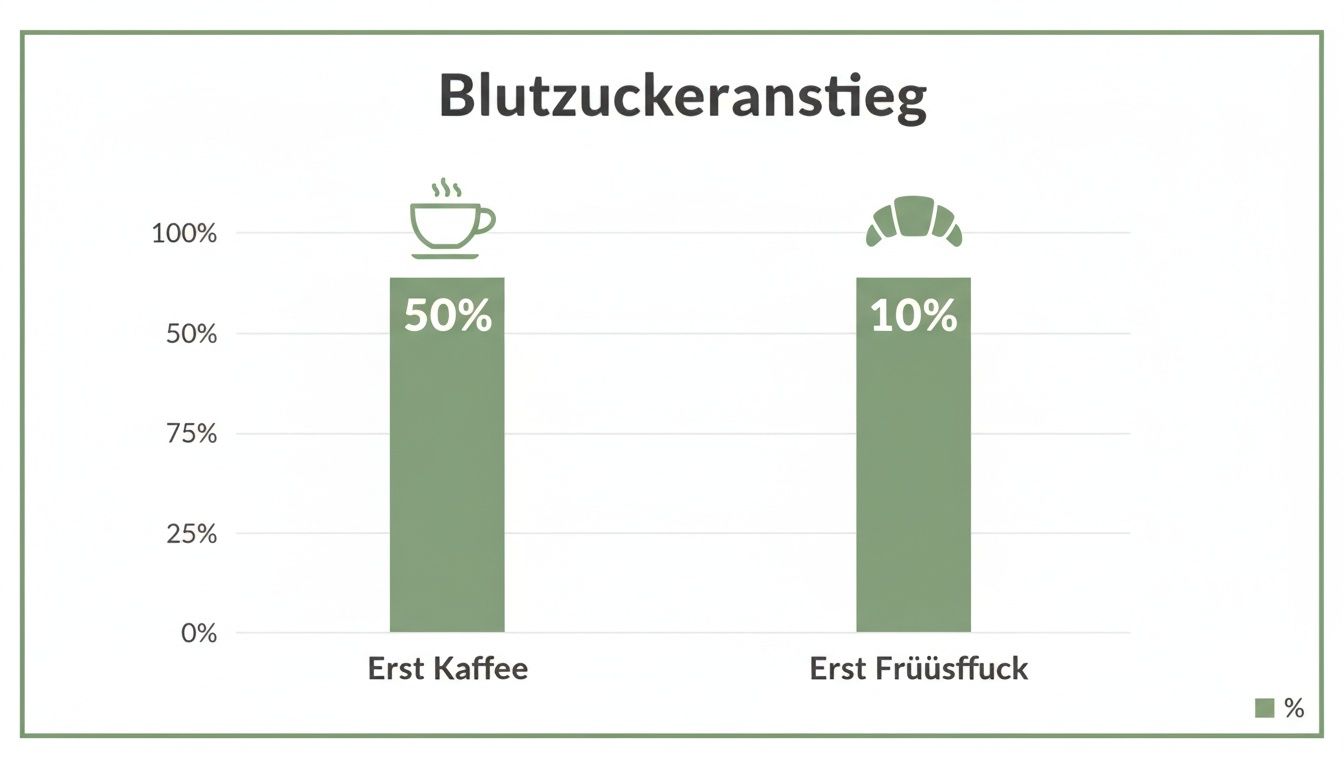
The data shows: Coffee before the first meal can raise blood sugar levels by as much as 50 % . Drinking it after breakfast results in a significantly smaller reaction.
Imagine a typical workday. You start with coffee on an empty stomach and feel temporarily energized. But by 11 AM, the first intense hunger pangs hit. After lunch, you then fall into a deep hole around 2 PM, your concentration wanes, and productivity drops.
These fluctuations, however, not only affect your job performance. They also rob you of the energy for your evening workout. Instead of feeling strong and vital, you struggle with the day’s exhaustion.
Here are the direct consequences of the blood sugar roller coaster:
If you break this cycle by eating first and then enjoying your coffee, you not only protect your hormonal system. You also secure stable energy that allows you to remain productive and balanced from morning until evening.

In addition to the hormonal chaos we’ve just highlighted, there is another direct reason to postpone the first coffee of the day a bit: your stomach. Coffee is naturally acidic and also contains compounds that significantly boost the production of stomach acid.
When this acid kick meets an empty, unprotected stomach, it can become quite uncomfortable. Your stomach lining gets irritated directly – the result is often heartburn, a burning sensation in the chest, or acid reflux.
Imagine pouring vinegar onto an unprotected wooden surface. The acid immediately attacks the surface. A breakfast acts here like a protective tablecloth, soaking everything up and neutralizing the aggressive effect.
If you already have a sensitive stomach or tend to suffer from digestive issues, you are particularly susceptible to this problem. Morning coffee can then not only trigger symptoms like stomach pain, bloating, or nausea, but can even worsen existing issues.
Even a small bite before your coffee can act like a shield for your stomach lining. The food dilutes the acid and ensures that it does not concentrate in one spot but mixes evenly with the food bolus.
This buffering effect is incredibly important for healthy digestion. Even a handful of nuts, a small yogurt, or a banana can make a huge difference and noticeably reduce the irritating effect of coffee.
One aspect that is often overlooked is the absorption of important nutrients. Certain compounds in coffee, primarily the tannins, can block the absorption of minerals in the gut.
This particularly affects iron and calcium – two essential nutrients for your energy and bone health. Drinking your coffee on an empty stomach can exacerbate this effect and contribute to a poorer nutrient supply in the long run.
Pay attention to these warning signals your body is sending you:
These symptoms are clear signs that your digestive system is overwhelmed by the acid. The right order in the morning is therefore crucial not only for your hormones but very directly for your gut feeling.
Okay, now you know why drinking coffee on an empty stomach can really mess with your hormonal system. The good news? You don’t have to give up your beloved coffee. Not at all. It’s simply about changing the order a bit and giving your body in the morning what it really needs to start the day gently and steadily.
With a few tiny but incredibly effective adjustments, you can build a morning routine that keeps your hormones in balance, provides you with constant energy, and avoids the dreaded afternoon slump. It’s about creating conscious habits that empower you rather than stress you out unnoticed.
Bevor du auch nur an die Kaffeemaschine denkst, gib deinem Körper die Chance, richtig aufzuwachen und sich zu rehydrieren. Nach Stunden ohne Flüssigkeit ist dein Körper dehydriert. Das Erste, was er braucht, ist Wasser – nicht Koffein.
Hier sind ein paar simple, aber effektive Alternativen für den allerersten Griff am Morgen:
Diese kleinen Rituale dauern nur wenige Minuten, verändern aber die gesamte biochemische Reaktion deines Körpers auf den Morgen. Wenn du merkst, dass Stress ein grosses Thema bei dir ist, kann es auch helfen zu lernen, wie du durch emotionsfokussiertes Coaching Stress reduzieren kannst, um dich auch auf emotionaler Ebene zu stärken.
Jetzt kommt der Game-Changer, um die Blutzucker-Achterbahn zu verhindern: Iss etwas, bevor du deinen Kaffee trinkst. Das muss kein aufwendiges Menü sein. Eine kleine, aber protein- und fettreiche Mahlzeit reicht völlig aus, um einen Puffer für das Koffein zu schaffen.
Dein erstes Frühstück ist das Fundament für den ganzen Tag. Gib deinem Körper erst die richtigen Bausteine, bevor du den Turbo zündest.
Hier sind ein paar schnelle und hormonfreundliche Ideen, die du in unter fünf Minuten auf dem Tisch hast:
Diese Optionen halten deinen Blutzuckerspiegel stabil. Das Ergebnis? Das Koffein wird langsamer und sanfter in dein System geschleust.
Nachdem du deinen Körper mit Flüssigkeit und Nährstoffen versorgt hast, ist es endlich Zeit für den Kaffee. Der ideale Zeitpunkt ist, wenn dein natürlicher Cortisolspiegel langsam wieder sinkt.
Das ist in der Regel nach 9:30 Uhr der Fall. Trinkst du deinen Kaffee erst dann, wirkt das Koffein am effektivsten, weil es nicht gegen deinen körpereigenen Wachmacher ankämpfen muss. So bekommst du den gewünschten Energieschub, ohne dein Hormonsystem zu überlasten. Wenn du tiefer einsteigen möchtest, wie du deinen Tag optimal gestaltest, schau dir unseren Leitfaden über Biohacking für Anfänger und Routinen für mehr Energie an.
Indem du diese drei einfachen Schritte befolgst, verwandelst du deine Morgenroutine von einer Stressquelle in eine echte Kraftquelle. Du wirst den Unterschied spüren: mehr Energie, bessere Konzentration und keine Heisshungerattacken mehr.
Hier ist eine kleine Übersicht über einfache und effektive Morgenrituale, die deinen Körper sanft wecken, anstatt ihn zu stressen.
| Alternative | Wirkung auf den Körper | Praktischer Tipp zur Umsetzung |
|---|---|---|
| Grosses Glas Wasser (lauwarm) | Rehydriert nach der Nacht, regt den Stoffwechsel an, ohne das System zu schocken. | Bereite das Glas schon am Abend vor und stelle es auf deinen Nachttisch. So ist es das Erste, was du siehst. |
| Wasser mit Zitrone & Salz | Liefert Elektrolyte (Natrium) und Vitamin C, unterstützt die Nebennieren und die Verdauung. | Presse den Saft einer halben Zitrone aus, füge eine Prise hochwertiges Meersalz hinzu und fülle mit Wasser auf. |
| Kurze Atemübung (2-3 Min.) | Versorgt dein Gehirn mit Sauerstoff, senkt dein Stresslevel und aktiviert den Parasympathikus (Ruhenerv). | Setz dich ans offene Fenster. Atme 4 Sekunden ein, halte 4 Sekunden die Luft an und atme 6 Sekunden aus. Wiederhole es 5-10 Mal. |
| Light Snack (Protein/Fat) | Stabilizes your blood sugar levels and prevents a cortisol and insulin spike from coffee. | A handful of almonds, a spoonful of nut butter, or a boiled egg. Quick, easy, and effective. |
These small habits take hardly any time but make a huge difference to your energy and well-being throughout the day.
Now that we’ve delved deep into the subject, there often remain a few specific questions. Absolutely understandable! Here I’ve gathered the most common ones for you and I’ll answer them clearly so you can clear up any last uncertainties.
Yes, a small one, but it doesn’t address the issue at its root. A splash of milk does provide some fat and protein. This can slightly delay caffeine absorption and buffer stomach acid.
The immediate effect on the stomach may feel a bit gentler because of this. However, the actual issue – the massive cortisol spike and the disturbance in blood sugar balance – remains. A latte on an empty stomach is indeed nicer to your stomach than a black espresso, but for your hormone balance, a proper breakfast is and remains the unbeatable better foundation.
A super important question that many people ask. Technically speaking, black coffee with its few calories does not break metabolic fasting. However, from a hormonal perspective, coffee right after waking is still not a good idea because it triggers the stress response we talked about – even without calories.
My tip: Push your coffee as close as possible to your first eating window. Instead, start the day with a large glass of water or an unsweetened herbal tea. This rehydrates your body much more gently.
If you absolutely need a caffeine kick during fasting, pay close attention to your body’s signals. Do you feel shaky, restless, or nervous? That’s an unmistakable sign that your system can’t handle this kick well without a solid food base.
In that case, you should consider adjusting your fasting window slightly to avoid these negative effects.
There is a simple rule of thumb that you can easily remember: 15 to 30 minutesafter eating is ideal. This little pause gives your body enough time to get digestion started and stabilize blood sugar levels.
The most important thing is that you have something in your stomach at all. Even a little something like a banana, yogurt, or a handful of nuts is enough to significantly cushion hormonal spike reactions. The goal is simple: to give caffeine a base so it doesn’t hit your empty system unbraked.
For everyone who simply loves the ritual and taste, this question is crucial. The answer is: partially. Decaffeinated coffee does not trigger the major problems, namely the strong cortisol surge and the blood sugar rollercoaster, to the same extent.
Thus, for the very early morning, it is a significantly better option.But beware: Even “decaf” naturally contains acids that stimulate the production of stomach acid.
So if you have a very sensitive stomach, even the decaffeinated version can lead to discomfort. However, for your hormone balance, it is definitely the safer choice if you just can’t do without your morning ritual.
Do you want to firmly anchor healthy habits like a hormone-friendly morning routine in your everyday life? At Templeshape GmbH, we support you with courses ranging from HIIT to breathwork and a community that motivates you. Find your flow and make health your habit at https://templeshape.com.
Tags
 DE
DE FR
FR EN
EN