March 18
Eat without regret: Why caloric deficits harm your metabolism
0 comments

The simple formula ‘eat less, move more’ sounds like a quick fix, but the reality is often quite different. An aggressive calorie deficit frequently leads to a dead end of frustration and a slowed metabolism. Why? Because your body switches to survival mode.Eating without regret is therefore not a luxury, but a biological necessity for long-term health and success.
You know the promise: Just reduce your calories, and the pounds will drop off. At first glance, that seems logical. Your body needs energy, and when it receives less than it burns, it has to tap into its reserves. But what really happens when you put your body on a constant diet?
The answer is much more complex than the simple calories in, calories out calculation would have us believe. Your body is an incredibly intelligent system that has been programmed for millennia to keep you alive. A permanent and severe calorie deficit is not interpreted as a conscious attempt to look better at the beach – it is interpreted as a famine.
In response to this perceived threat, your body activates a whole range of protective mechanisms. Its sole aim: to save energy wherever possible.
Specifically, this means:
This condition is the perfect breeding ground for the dreaded yo-yo effect. As soon as you start eating ‘normally’ again, your body stores the extra energy with all its might as fat – to be better prepared for the next famine.
Your body is not fighting against you but for you. It is trying to secure your survival. A drastic calorie reduction is an existential threat to it.
This quick comparison shows the short-term ‘successes’ of a crash diet versus the long-term benefits of sustainable, mindful eating.
| Aspect | Crash diet (severe calorie deficit) | Sustainable nutrition (mindful eating) |
|---|---|---|
| Results | Faster, but often short-lived weight loss (water & muscles) | Slower, but steady and sustainable fat loss |
| Metabolism | Slows down significantly to save energy (‘famine mode’) | Remains active or is even boosted by muscle building |
| Hormones | Stress hormones rise, satiety hormones fall | Hormonal balance is promoted, cravings decrease |
| Mental well-being | Often leads to frustration, cravings, and feelings of guilt | Promotes a positive relationship with food, increases energy |
| Sustainability | Practically impossible to maintain long-term (yo-yo effect) | Becomes a lifelong, flexible habit |
In the end, the choice is clear: While crash diets lead you into a vicious cycle of deprivation and setbacks, a sustainable strategy builds health and well-being from the ground up.
This problem is widespread. The constant hunt for the perfect diet is often a reaction to societal pressure and genuine health concerns. Data from the Federal Statistical Office from 2022 shows that already 43% of the Swiss population were overweight or obese. And forecasts indicate that this trend will continue to increase.
These figures make one thing very clear: Simple diet approaches that ignore the body are not the solution. The background of overweight in Switzerland on dropa.ch sheds more light on the issue.
It is therefore not about punishing your body with deprivation. It is about working cleverly with it. You will understand why strict calorie counting often does more harm than good and why Eating without regret is the true key to a healthy metabolism. If you want to delve even deeper into this topic, be sure to read our article on why Counting calories can be a dangerous trend.
Think of your metabolism as a clever power plant. Its job? To convert food into the energy you need for absolutely everything – from breathing to thinking to your next workout. As long as this power plant receives good fuel regularly, everything runs smoothly.
But what happens if supplies suddenly run dry? A short, small deficit is easily managed by your body. However, if you give it far too little energy for weeks or even months, alarms start ringing in the power plant.
Your body can’t differentiate between a diet and a real famine. For it, this ongoing deficiency is an existential threat. To ensure your survival, it initiates stringent countermeasures and switches to a rigorous energy-saving mode. This clever but fatal protective mechanism for your goals is called metabolic adaptation.
Metabolic adaptation is not a myth from some fitness magazine, but a real, measurable process. Your body becomes incredibly creative in reducing its energy consumption to cope with scarce resources. Instead of continuing to run at full throttle, it systematically reduces performance.
Specifically, here’s what happens:
Basically, your body is sending out a distress signal: "Attention, crisis! Shut down all non-essential consumers. We need to maximize efficiency to get through this."
This graphic illustrates how a constant calorie deficit pulls you into a vicious cycle of frustration, yo-yo effects, and an ever-slowing metabolism.
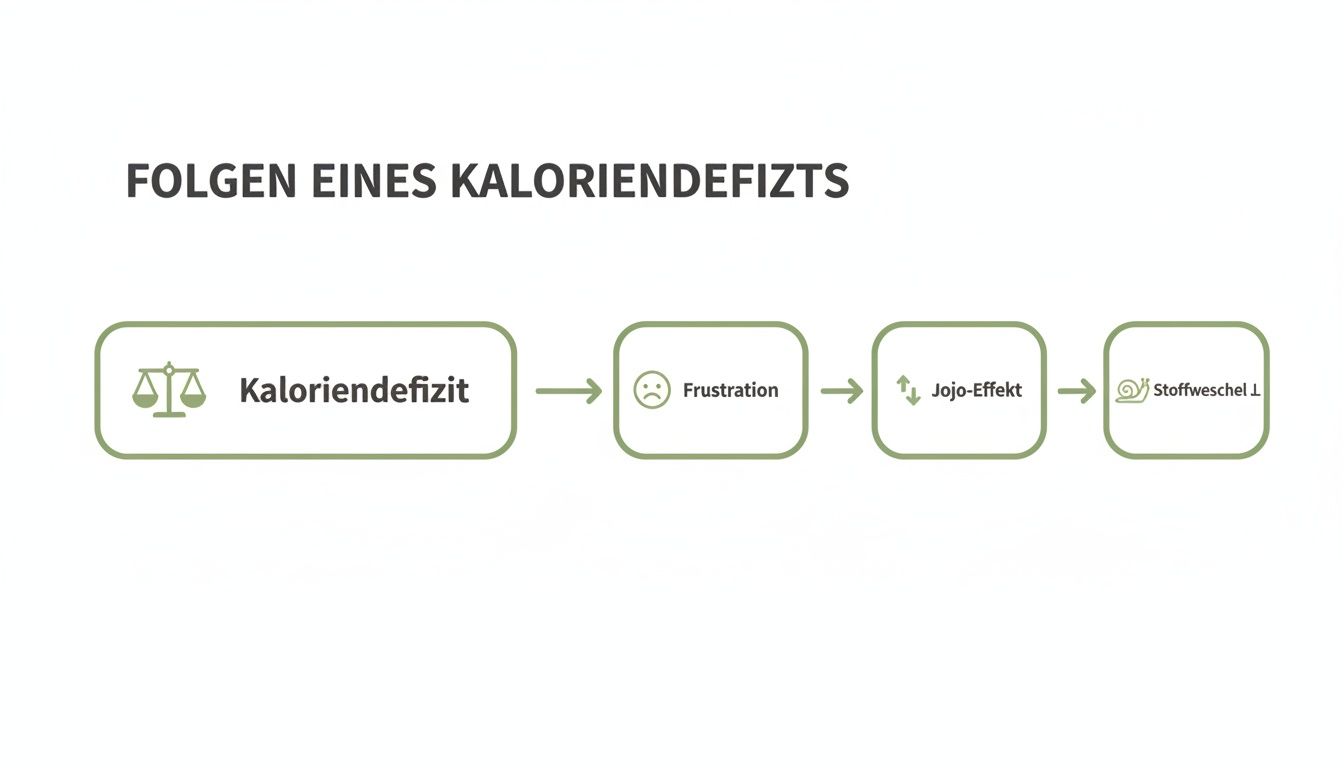
As you can see: Your body’s reaction is not a simple slowdown. It’s a whole cascade of adaptations that often leaves you miles away from your actual goal.
This energy-saving mode, of course, doesn’t go unnoticed. Your body sends you unmistakable signals that its power plant is no longer running smoothly but is fighting for every single calorie. Perhaps some of these sound familiar.
Example from your daily life:
You sit in the office. Your colleagues find the room temperature pleasant, but you wrap yourself in a blanket, shivering. Your hands and feet are constantly ice-cold. This is no coincidence. Constantly feeling cold is a classic symptom that your body is slowing down thermogenesis – its heat production – to save energy.
Other typical warning signals you should absolutely pay attention to:
If you notice these signals in yourself, your body is not fighting against you. It is trying to communicate with you and protect you from the long-term consequences of a too-severe deficit.Eating without regretmeans exactly that: listening to these signals and working with your body again instead of continuing to starve it.
After shedding light on the dark side of a severe calorie deficit, you might be wondering: Is every deficit bad? Absolutely not. That’s a misconception that hinders many on their journey to their goals. A calorie deficit is and remains the requirement for fat loss. The key point is, how you achieve this deficit.
The way you create this energy deficit sends completely different signals to your body. Physiologically, there are worlds of difference between a deficit created by starvation and one that you earn through movement and effort.
Imagine this in two very concrete scenarios:
For your metabolism, these are two completely different stories. In the first case, you’re sounding the alarm: famine! In the second case, you’re sending a strong signal: "We’re active, we need energy – be ready to perform and draw on our reserves!"
A calorie deficit created through activity is not an alarm signal for famine but a training stimulus for an efficient and flexible metabolism.
Your body responds to this stimulus not with panic, but with clever adaptations. It learns to tap into its energy sources more efficiently – specifically, the fat reserves, instead of sacrificing valuable muscle mass.
To make this even clearer, let’s take a look at extreme athletes. An ultra-cyclist can easily during a race Burning 750 to 850 calories per hour.To cover this insane consumption, he might eat 6000 calories a day – and still be in a massive but healthy calorie deficit.
His body doesn’t even think about entering starvation mode. On the contrary: His metabolism is running at full speed. He is trained to draw a huge part of his energy directly from fat reserves; a fat burning rate of up to 60 % is present here. The ample supply of nutrients signals to him that there is no crisis and he can keep going full throttle. You can find more exciting insights on this at 20 minutes.
What does that mean for you? You don’t have to ride bike marathons, of course. But the principle remains the same: A high energy output through movement, combined with top nutrient supply, keeps your metabolism active.
The key is to purposefully raise your energy expenditure instead of drastically cutting your intake. This is the foundation for sustainable success without sabotaging your metabolism.
Here are a few concrete approaches that really work:
A calorie deficit created by movement – that’s the way to eat without guilt. It allows you to optimally nourish your body, reach your goals, and make your metabolism a strong partner instead of an enemy.
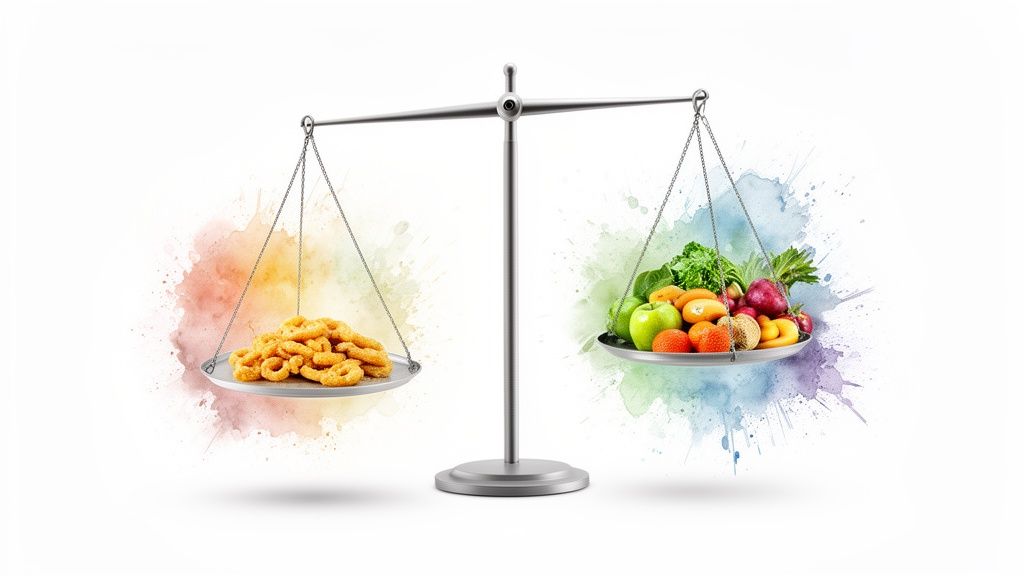
Imagine your metabolism like a fire. Calories are just the wood you feed it. But how well this fire burns depends on entirely different factors. The quality of your food, how deeply you sleep, and how you handle stress – these are the real accelerators. And these are often completely overlooked.
It’s not just about how much you eat, but especially about what lands on your plate. Your body reacts to 200 calories from a fresh salad with chicken fundamentally differently than to 200 calories from a chocolate bar. The equation is therefore much more complex than it seems at first glance.
Highly processed foods are designed to hijack the reward systems in your brain. They are packed with sugar, fat, and salt – a combination that makes it incredibly hard for us to stop eating even when we are full. Your body gets calories, but almost no valuable nutrients.
This is not a figment of imagination, but well supported by science. In Switzerland, such foods already make up about a quarter of what we consume daily. A well-known study showed that participants who mainly ate highly processed foods (so-called “Ultra-Processed Foods”) consumed, on average, about 500 kcal more per day than a comparison group that received unprocessed food. And this, despite the fact that the meals were adjusted in terms of calories, fat, and sugar. You can find more about this in the insights on weight reduction at rosenfluh.ch.
Eating without guilt starts with the conscious choice of your food. Give your body the fuel it really needs – not just empty calories.
By choosing natural foods, you not only nourish your cells but also give your mitochondria, the small power plants of your body, a real boost. If you want to learn how to power up these energy suppliers, take a look at our guide on how to activate your mitochondria.
Another incredibly powerful but often neglected factor is your sleep. Just one night of too little or poor sleep can throw your hormones out of balance and sabotage your metabolism.
What happens exactly?
Sleep is therefore not a waste of time. It is a phase of active regeneration, absolutely essential for a healthy metabolism.
Chronic stress puts your body in a constant state of alert. Your brain cannot tell the difference between fleeing a saber-tooth tiger or simply an approaching project deadline. The physical reaction is the same: the release of the stress hormone cortisol.
A typical example from your daily life:
Imagine you have a demanding job in the city. Meetings, deadlines, always being reachable. In the evening, you try to ‘relax’ with a glass of wine. But this combination can be fatal.
Active stress management – whether through movement, yoga, or simple breathing exercises – is therefore not a luxury. It is a cornerstone for bringing your metabolism back into balance and staying sustainably healthy.

If you recognized yourself in the previous paragraphs – constantly tired, frustrated by stagnation on the scale, and always shivering – then it’s time to finally break this vicious cycle of dieting. Your metabolism is not broken. It has simply adapted cleverly to the circumstances. And the best news is that you can get it back on track.
The key is to signal to your body that the famine is over. You need to regain its trust and show it that it is receiving energy regularly and sufficiently again. Only then will it abandon its conservation mode and operate at full power. Of course, this takes a bit of patience and a clear strategy, but it’s the only way to achieve a body that works sustainably for you – not against you.
One of the most effective methods for this restart is what is called Reverse Dieting.Consider it simply as the exact opposite of a drastic diet. Instead of drastically cutting calories, you increase them very slowly, step by step, and in a completely controlled manner.
The goal is simple: teach your metabolism to process more energy without your body immediately storing it as fat. You gradually give your energy center, so to speak, more fuel so that it can increase its performance. This process is ideal for reversing the targeted metabolic adaptability.
Reverse Dieting is not a blank check to eat without control. It is a strategic and patient method to revitalize your metabolism and restore your hormonal balance.
This approach can initially be a real mental challenge. After months or even years of deprivation, conscientiously starting to eat more requires courage. But it is the decisive step to establish a relaxed and healthy relationship with food again.
Alongside Reverse Dieting, it is equally important to listen again to the signals from your body. Dieting for years and rigid meal plans have often made us forget what true hunger is or when we are really full. Eating intuitively is nothing more than the ability to perceive these internal signals again and trust them.
To retrain this ability, a few simple steps can help you:
An example for you:
Imagine a working mother who can often only eat standing up between meetings and childcare. She can practice mindfulness by consciously reserving 15 minutes solely for her lunch. During this time, she eats slowly, chews well, and is completely present. Just that can make a huge difference to her feeling of satiety and digestion.
To help you better envision the startup, we have created a simple weekly overview for you. It shows you how you can slowly and safely increase your caloric intake, starting from your current caloric intake (low).
| Week | Strategy | Focus | An example for you |
|---|---|---|---|
| Week 1-2 | Increase calories by 50-100 kcal per day | Stability and observation. Your weight should remain stable or fluctuate only slightly. | Add a small protein-rich snack, such as Greek yogurt or a handful of nuts in the afternoon. |
| Week 3-4 | Increase by another 50-100 kcal | More energy in training. You should notice that you have more strength and endurance in the HIIT class or yoga. | Increase your portion of carbohydrates after training, e.g., half a cup of quinoa or an extra small sweet potato. |
| Week 5-6 | Further increase by 50-100 kcal | Hormonal balance. Pay attention to signals such as better sleep, less cravings, and a more stable mood. | Incorporate an additional serving of healthy fats, such as a quarter of an avocado for breakfast or some olive oil over your salad. |
| From Week 7 | Repeat the process until the goal is reached | Long-term adjustment. Keep gradually increasing until you reach your maintenance calories and your metabolism has normalized. | Enjoy larger, balanced meals that truly satisfy and nourish you, without fear of weight gain. |
This path takes you step by step back to a state where food becomes what it should be: valuable energy, pure enjoyment, and a central building block for your health. That is what we understand by a true Guilt-free eating.
At Templeshape, we do not chase short-term goals. We know from experience: real, lasting change takes time and an approach that suits you and your life. That’s what we’re all about – your long-term health and the joy of movement.
Let’s bundle all the insights about metabolism and transform them into a strategy that empowers you rather than punishes you.
Forget the idea of disciplining your body through deprivation. We invite you to nourish and challenge it through variety. Your metabolism loves diversity! Our wide range of courses is specifically designed to build a robust and flexible metabolism that carries you through daily challenges.
A healthy metabolism is never the result of a single diet or a specific workout method. It is the result of a lifestyle that gives your body what it truly needs on all levels.
Here’s how we specifically support you:
To sustainably push your metabolism and enjoy a Guilt-free eatingit is also important to understand the positive effects of healthy eating at workbecause what you eat during the day lays the foundation for your evening.
Chronic stress is one of the biggest saboteurs of your metabolism. It disrupts your hormones and puts your body in a constant state of alarm. That’s why mindful practices like breathwork are an integral part of our concept.
In a positive and appreciative atmosphere, you will learn how to actively reduce stress and bring your body back into its natural balance.
We do not see movement and nutrition as a duty, but as a strengthening and positive part of your life. Your path to a healthy metabolism starts right here: with the decision to finally work with your body instead of against it.
We want to help you internalize this new understanding. If you want to dive deeper and learn how to specifically boost your metabolism, check out our article on the 5 best ways through nutrition and exercise.
Consider this your personal invitation to redefine health – with joy, energy, and no guilt.
Phew, that’s a lot of information at once, right? The topic of metabolism, diets, and the eternal fear of the yo-yo effect is a jungle of myths and half-truths. It’s easy to get overwhelmed.
That’s why we have gathered the most burning questions for you here. We provide you with clear, scientifically-based answers so you can finally see through it and make the right decisions for yourself and your health. It is completely normal to feel uncertain – especially when you have heard contradictory advice for years. Let’s bring light to the darkness together and restore your confidence in your own body.
Yes, absolutely! And that is the most important message of all. Your metabolism is not truly ‘broken’ – it has just incredibly intelligently adapted to a perceived famine to protect you. This state is completely reversible.
With a smart and patient strategy, such as Reverse Dieting, you can signal to your body: ‘The crisis is over, you are safe.’ By slowly and controlled increasing your calories again, you give your metabolism the chance to rev up its engines again.
Targeted strength training to build valuable muscle and conscious stress reduction are your best allies in this. It takes some time, no doubt, but your body is a marvel of adaptation and can fully regenerate.
It’s the famous question “It depends”. Unfortunately, there is no simple answer that fits everyone, as the recovery phase is as individual as you are.
Several factors play a determining role:
Basically, you can expect a period of a few weeks to several months. The important thing is to be patient with yourself and your body. Focus on the small positive signals – more energy in daily life, better sleep, fewer cravings – instead of solely fixating on the number on the scale.
The key is not speed, but sustainability. Give your body the time it needs to regain its balance and trust you again.
We are all too familiar with this fear. It is the main reason why so many people remain trapped in the vicious cycle of dieting. But here’s the good news: If you proceed slowly and in a controlled manner, like with Reverse Dieting, the risk of significant fat gain is minimal.
A slight weight increase at the very beginning is even quite likely and often a good sign! It generally involves replenished glycogen stores (hence carbohydrates in your muscles) and the associated water – not body fat.
Your goal is to allow your metabolism to get used to a higher caloric intake. If you gradually give it energy back, it has the chance to get its “engine” running again instead of panicking and storing the excess as fat. Eating more to heal your metabolism is the first step towards aGuilt-free eating.
Are you ready to finally break the vicious cycle of diets and frustration? Do you want to establish a healthy, strong, and lasting relationship with your body? AtTempleshape GmbHwe support you on this journey – with activities you enjoy, a community that supports you, and the knowledge you need to take your health into your own hands.
Tags
 DE
DE FR
FR EN
EN