March 18
Magnesium deficiency: The master mineral for relaxation – Your path to tranquility
0 comments

March 18
0 comments
Fühlst du dich oft überfordert, müde oder angespannt? Wenn ja, bist du damit nicht allein. Was viele nicht wissen: Ein Magnesium-Mangel könnte die unsichtbare Ursache dahinter sein. Dieses Mineral ist nämlich absolut entscheidend für deine Fähigkeit, wirklich zu entspannen und Stress abzubauen. Man könnte fast sagen, Magnesium ist das natürliche Beruhigungsmittel für dein Nervensystem.
Stell dir deinen Körper einmal wie ein riesiges Orchester vor. Damit die Musik am Ende harmonisch klingt, braucht es einen Dirigenten, der jedem Instrument den richtigen Einsatz gibt. Genau diese Rolle übernimmt Magnesium in deinem Körper – es dirigiert das Zusammenspiel von Nervensystem und Muskeln.
Fehlt dieser Dirigent, gerät das ganze System aus dem Takt. Die Folge ist ein inneres Chaos: Deine Nerven sind ständig überreizt, die Muskeln verkrampfen viel leichter und du fühlst dich, als stündest du permanent unter Strom. Das ist kein Zufall, denn Magnesium greift direkt in unsere Stressachse ein.

Wenn du Stress hast, schüttet dein Körper das Hormon Cortisol aus – es versetzt dich in Alarmbereitschaft. Hier kommt Magnesium ins Spiel: Es wirkt als natürlicher Gegenspieler und hilft, die Ausschüttung von Cortisol zu drosseln. Liegt ein Mangel vor, kann dieser Regulationsmechanismus gestört sein, und dein Stresslevel bleibt chronisch erhöht.
Gleichzeitig kurbelt Magnesium die Produktion eines wichtigen Botenstoffs im Gehirn an: GABA (Gamma-Aminobuttersäure). GABA wirkt beruhigend auf dein zentrales Nervensystem und bremst neuronale Überreaktionen aus. Stell es dir einfach wie das Bremspedal für dein Gehirn vor.
Magnesium ist so viel mehr als nur ein Mineral – es ist ein fundamentaler Baustein für deine innere Ruhe. Es hilft deinem Körper, vom „Kampf-oder-Flucht“-Modus in den „Ruhe-und-Verdauungs“-Modus umzuschalten.
Die Anforderungen unseres modernen Lebens – sei es in deinem anspruchsvollen Job, als Mutter oder im Rahmen von Corporate-Health-Programmen – lassen deinen Magnesiumbedarf regelrecht in die Höhe schnellen. Viele Menschen fühlen sich durch ihren Job stark belastet. Gerade in Berufen wie der Pflege wird dies oft durch strukturelle Probleme wie ständigen Überstunden wegen Personalmangels zusätzlich verstärkt.
Ein Magnesium-Mangel sabotiert also direkt deine Fähigkeit zur Entspannung. Die gute Nachricht: Du kannst diesen Kreislauf durchbrechen. Sobald du verstehst, wie dieses Master-Mineral für Entspannung funktioniert, ist der erste Schritt getan, um deine innere Balance wiederzufinden. Neben der richtigen Ernährung macht auch Bewegung einen gewaltigen Unterschied. In unserem Artikel erfährst du mehr darüber, wie du gezielt Stressabbau durch Sport und Yoga erreichen kannst.
Die nächsten Abschnitte zeigen dir ganz konkret, wie du die Anzeichen eines Mangels erkennst und was du dagegen tun kannst.
Ein Magnesiummangel klopft selten laut an deine Tür. Viel häufiger schleicht er sich leise in deinen Alltag, getarnt als alltägliche Beschwerden, die du vielleicht einfach auf Stress oder zu wenig Schlaf schiebst. Doch genau diese subtilen Signale sind es, die dir dein Körper sendet, wenn ihm das entscheidende „Entspannungs-Mineral“ fehlt.
Vergiss für einen Moment die klassischen Wadenkrämpfe – die sind zwar ein bekanntes, aber bei Weitem nicht das einzige Anzeichen. Ein Mangel an Magnesium kann sich auf vielfältige Weise zeigen und sowohl deine körperliche als auch deine mentale Leistungsfähigkeit spürbar beeinträchtigen.

Fühlst du dich oft schon morgens wie gerädert, obwohl du vermeintlich genug geschlafen hast? Diese ständige, unerklärliche Erschöpfung ist ein typisches Warnsignal. Magnesium ist an über 300 Stoffwechselprozessen beteiligt, die Energie für deine Zellen produzieren. Fehlt es, läuft dein Körper quasi auf Sparflamme. Alles über die Ursachen und was du dagegen tun kannst, erfährst du in unserem Artikel über Müdigkeit bekämpfen – Ursachen und Tipps.
Aber die Anzeichen gehen noch weiter. Vielleicht kennst du das Gefühl, innerlich unruhig oder ständig nervös zu sein, ohne einen konkreten Grund dafür zu haben. Deine Gedanken kreisen, du kannst schlecht abschalten und bist leicht reizbar. Das liegt daran, dass Magnesium dein Nervensystem beruhigt. Bei einem Mangel sinkt die Reizschwelle – du reagierst einfach empfindlicher auf Stress.
Diese Tabelle zeigt dir auf einen Blick, welche körperlichen und mentalen Anzeichen auf einen Magnesiummangel hindeuten und welche Prozesse im Körper dahinterstecken.
| Symptom | Mögliche körperliche Ursache | Beispiel aus deinem Alltag |
|---|---|---|
| Schlafprobleme | Magnesium reguliert Schlafhormone wie Melatonin und beruhigt das Nervensystem. Ein Mangel stört diesen Rhythmus. | Du wälzt dich stundenlang im Bett, wachst nachts oft auf oder fühlst dich morgens trotz 7-8 Stunden Schlaf nicht erholt. |
| Kopfschmerzen & Migräne | Fehlendes Magnesium führt zu Verspannungen der Muskulatur und Blutgefässe im Kopf- und Nackenbereich. | Du leidest häufig unter Spannungskopfschmerzen, besonders nach einem langen Tag am Schreibtisch. |
| Heisshunger auf Schokolade | Dein Körper signalisiert instinktiv den Bedarf an magnesiumreichen Lebensmitteln. Dunkle Schokolade ist eine Top-Quelle. | Am Nachmittag überkommt dich ein fast unbezwingbarer Appetit auf Schokolade, obwohl du eigentlich keinen Hunger hast. |
| Muskelzucken | Das Nervensystem ist übererregt, was zu unkontrollierten, feinen Muskelkontraktionen führt. | Dein Augenlid zuckt seit Tagen immer wieder oder du bemerkst feine Zuckungen im Oberschenkel nach dem Sport. |
Oft ist es die Summe dieser kleinen, aber hartnäckigen Beschwerden, die auf einen Mangel hindeutet.
By the way, these symptoms are particularly common in Switzerland. A comprehensive study by the Federal Office of Food Safety and Veterinary Affairs (BLV) shows that a large part of the population does not reach the recommended magnesium intake. Particularly young women aged 18 to 34 often consume too little with an average of only 282 mg per day, even though the reference values are between 300–310 mg. You can find more about these exciting findings in the detailed report of the BLV.
To make these abstract symptoms more tangible, let’s look at two typical examples that you might know from your own surroundings.
Case Study 1: The working mother
Anna juggles a demanding job with family life. In the evenings, she is completely exhausted, yet cannot fall asleep because her mind is racing. At night, she often wakes up with tense shoulders and suffers from headaches during the day. She attributes her intense cravings for chocolate in the afternoon to stress – yet it could be a cry for help from her body for magnesium.
Case Study 2: The stressed manager
David is constantly under pressure at work. He has noticed for some time a constant twitching of his eyelid and often feels nervous and unfocused. Although he exercises regularly, he suffers from muscle cramps more often after workouts than before. His inner tension makes it difficult for him to truly unwind after work.
Both examples show how a magnesium deficiency manifests in everyday life. It is not the dramatic disease pictures, but rather a sum of small complaints that gradually reduce your quality of life. By learning to interpret these subtle signs correctly, you take the first and most important step to regain your energy and inner peace.
You pay attention to your diet but still often feel drained, tense, or simply not at your best? Don’t worry, you are absolutely not alone. Many people wonder why they lack this essential “relaxation mineral” even though they are making an effort. The answer is often more complex than just “eating too little spinach” – it is deeply rooted in our modern lifestyle.
A magnesium deficiency rarely sneaks in because of a single mistake. Most often, it is a combination of several factors. Think of your magnesium level like a bank account: if your expenses (consumption) constantly exceed your income (intake), you slip into the negative. Exactly this happens with your body’s own stores.
Even if you shop mindfully, it has become a real challenge to cover your magnesium needs solely through food. A big problem lies in our soils. Due to intensive agriculture, they are often so depleted that they contain significantly fewer minerals than they did 50 years ago. This means: the carrot or broccoli on your plate often provides less magnesium today than the veggies from grandma’s garden.
Additionally, there is the high proportion of heavily processed foods in our diet. During the processing of whole grains to white flour or from sugar beets to refined sugar, up to 80 % of the original magnesium content is lost. These “empty” foods may fill your stomach, but not your mineral stores – and quickly pull your balance down.
A magnesium deficiency is rarely the result of insufficient effort. Much more often, it is a direct consequence of our modern environment and eating habits.
Is your everyday life demanding? Are you juggling a challenging job, family, and perhaps even intense training sessions at Templeshape? Right here lies one of the biggest magnesium thieves of our time: stress.
Under pressure, your body releases stress hormones like cortisol and adrenaline. This reaction forces your cells to release magnesium, which is then increasingly excreted through urine. The more stress you have, the faster your stores empty. The tragic part is the vicious cycle: stress consumes magnesium, and a magnesium deficiency makes you more susceptible to stress.
The same applies to exercise. If you exhaust yourself in an intense HIIT workout or train for a Hyrox competition, you lose valuable minerals like magnesium through sweat, not just water. At the same time, your body urgently needs the mineral for muscle contraction, energy production, and the crucial recovery afterward.
Your need can therefore quickly shoot up, especially due to:
In addition to diet and stress, there are a few other habits that silently gnaw at your magnesium reserves in everyday life. These factors can significantly increase the excretion of the mineral and promote a deficiency.
Coffee and alcohol
Your beloved coffee in the morning or a glass of wine in the evening can stimulate magnesium excretion through the kidneys. Caffeine and alcohol have a diuretic effect, which leads to more minerals being flushed out of your body than normal. If you consume regularly, you can noticeably pull your magnesium balance into the negative.
Certain medications
Some commonly prescribed medications are also known as magnesium thieves. They can either block absorption in the intestines or increase excretion through the kidneys. These include:
If you recognize yourself in one or more of these points, that is the first and most important step toward improvement. It’s not about becoming perfect overnight. It’s about understanding the true causes so that you can take targeted action. In the next section, we will show you how to cleverly and sustainably refill your stores.
The good news is: A magnesium deficiency is not a fate you simply have to accept. Quite the contrary! You can specifically and sustainably refill your stores – and usually without expensive powders or pills, directly through your plate.
This section is your practical roadmap for a diet rich in this important relaxation mineral. We focus on how to easily integrate magnesium power into your everyday life so that you feel energized and calm again.
Think of magnesium as everything that is green, nutty, and whole. Mother Nature has gifted us a wealth of delicious foods that are brimming with this valuable mineral.
Your shopping list for full magnesium stores might look like this:
This variety makes it easy for you to naturally incorporate magnesium into your meals.
Knowledge is good, but implementation is better. It’s not about completely overhauling your meal plan. Often, it’s the small, conscious adjustments that make the biggest difference.
Imagine building one small habit after another. Each magnesium-rich meal is like a deposit into your personal “relaxation account.” Over time, these contributions add up and pay off in the form of more energy and inner peace.
Here are a few simple ideas you can implement right away:
These small changes fit into even the fullest of schedules and help you effortlessly increase your intake.
It’s one thing to eat magnesium-rich foods. It’s another to ensure that your body actually absorbs the mineral. This process is called bioavailability, and with a few tricks, you can significantly improve it.
An important partner for magnesium is vitamin B6. It acts almost like a key, helping to transport magnesium into your cells. Good sources of vitamin B6 include bananas, chickpeas, salmon, or poultry.
Also, avoid combining magnesium-rich meals with foods that are very high in calcium, like a large glass of milk. Both minerals compete for absorption in the intestines, and an excess of calcium can slow down magnesium absorption.
The reality in Switzerland shows that a conscious diet is important. According to the menuCH study, women of all age groups on average do not reach the recommended reference values for magnesium. Particularly in the Romandy and Ticino regions, women’s intake often only reaches 85–90 % of the target. An exception is men in German-speaking Switzerland between 35 and 50 years old. They are the only group that, at around 105 % exceeds the reference value. You can find more insights in the results of the national nutrition survey..
By focusing on a nutrient-rich diet and smart combinations, you lay the foundation for a balanced magnesium level – and thus for more relaxation and well-being.
Of course, a magnesium-rich diet should always come first. However, there are life phases and situations in which your need increases so much that you can hardly meet it through food alone. That’s exactly when high-quality magnesium supplements can be a really sensible addition to specifically replenish your stores and secure your well-being.
It’s not about blindly following a trend. It’s about strategically supporting your body when it needs it most. Certain circumstances are indeed real “magnesium robbers” and simply require a higher intake.
Not everyone needs to immediately reach for capsules or powders. But for certain groups, an additional dose of magnesium can make a noticeable difference in energy and inner peace.
This decision tree gives you a quick orientation on whether a supplement is worth considering for you.
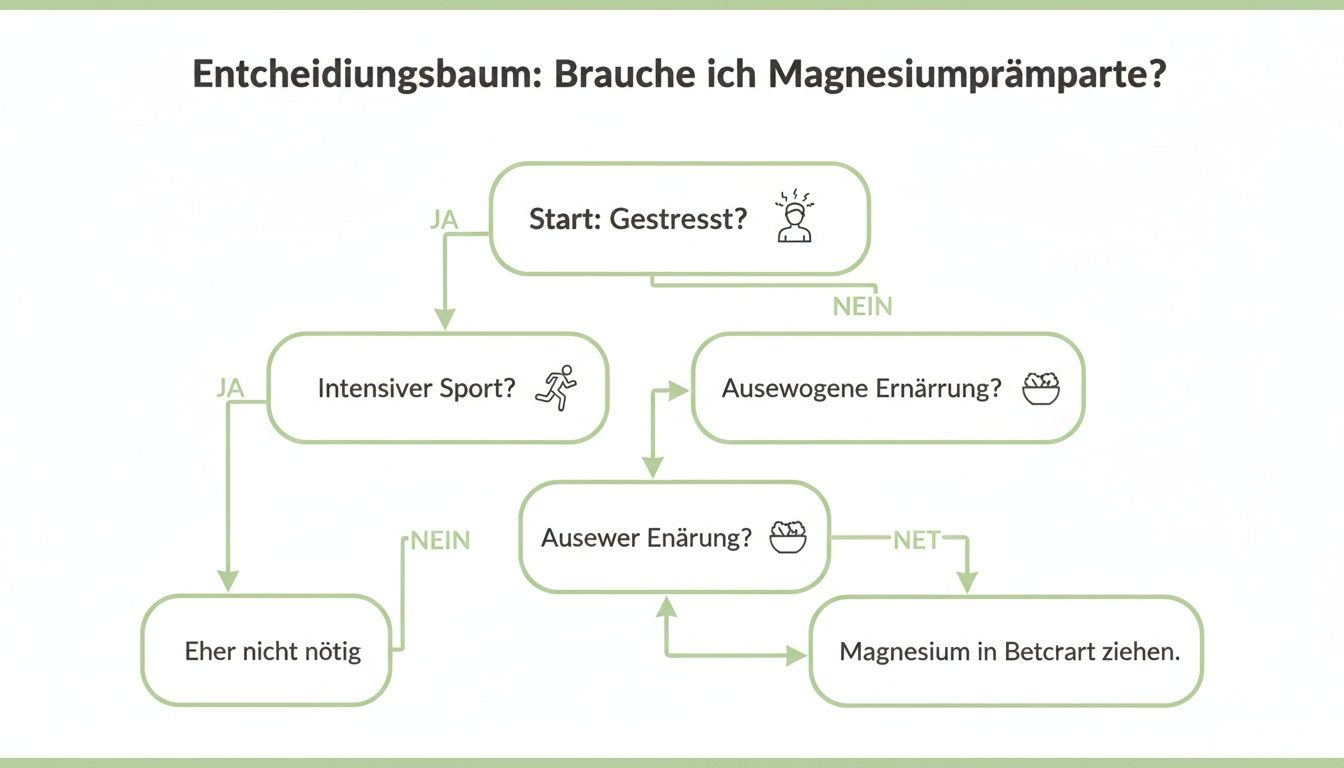
The graphic clearly shows: Your lifestyle and diet are the determining factors that govern whether additional magnesium makes sense for you.
When you decide on a supplement, you quickly stand in front of a huge shelf. The key is the chemical compound to which magnesium is bound. This compound determines how well your body can absorb the mineral (Bioavailability) and for which purpose it is best suited.
Choosing the right form of magnesium is crucial for its effect. Think of it like buying running shoes: you choose the exact model that fits your goal – whether it’s a short sprint or a long marathon.
So when you stand in front of the shelf, it’s good to know which form is right for you.
A comparison of the most common magnesium compounds, their bioavailability, and their specific benefits for relaxation, digestion, and muscle health.
| Magnesium form | Main benefit | Ideal for you |
|---|---|---|
| Magnesium citrate | Very well bioavailable, has a mild laxative effect | Quickly replenishing your stores, supporting digestion |
| Magnesium glycinate | Excellently bioavailable, very stomach-friendly, calming effect | Stress relief, better sleep, and relaxation (your top choice!) |
| Magnesium oxide | High magnesium content, but low bioavailability | Short-term relief of constipation, less for correcting deficiencies |
In short: If your goal is inner peace and better stress resistance, then Magnesium glycinateis clearly the best choice for you.
The market for dietary supplements is booming, and for good reason. In Switzerland alone, an impressive 1.9 million packagesof magnesium supplements were sold, totaling an income of 65 million francs – a substantial increase since 27 %2019. However, despite this popularity, around 29% of womenand 26% of menstill suffer from a deficiency. This shows how important the right selection and application are. You can read more about the background of this trend in Switzerlandhere.
Knowledge about magnesium is the first important step. However, the real magic happens when you bring that knowledge into your daily life. It’s not about turning your life upside down overnight. Your path to more relaxation begins with small, conscious decisions that develop into powerful habits over time.
The goal is a lifestyle that naturally supports your magnesium balance and sustainably strengthens your resilience against stress. Think of it like muscle building here at Templeshape: Continuity and the right technique bring success, not the one-time effort.
Even tiny adjustments to your daily routine can make a huge difference for your well-being. It’s these little rituals that signal to your body: It’s time to switch from stress mode to recovery mode.
Here are a few simple but effective strategies that you can try immediately:
These practices are the perfect complement to a magnesium-conscious diet. Together, they create a solid foundation for your inner balance.
Your path to a relaxed life is not a sprint, but a marathon. Every conscious decision for a magnesium-rich meal or a short relaxation break is a step in the right direction.
In the end, it’s about finding a routine that suits you and your life. Maybe it’s the magnesium-rich smoothie in the morning, a handful of nuts in the afternoon, or the evening intake of magnesium glycinate. Combine these building blocks with practices that help you mentally switch off.
By cleverly combining nutritional knowledge, targeted supplementation when needed, and relaxation-promoting habits, you create a strong shield against the stress of everyday life.
If you want to dive deeper into relaxation techniques, you’ll find valuable tips on the topic in our guide mindfulness. Your journey to a more relaxed, energetic self begins now – with the first small, conscious decision.
You’ve now learned a lot about the central role of magnesium for your relaxation and stress levels. Still, specific questions often arise at the end. Don’t worry, that’s completely normal.
Here I’ve gathered the most common uncertainties for you and will answer them briefly so you can start implementing with a good feeling.
This is a very individual matter and strongly depends on how depleted your stores really are and which form of magnesium you choose. In acute situations like painful muscle cramps, a higher dose of a well-absorbed magnesium citrate can often bring noticeable relief within a few hours.
However, when it comes to the deeper effects on your nervous system – that is, stress, inner restlessness, and sleep problems – you need a bit more patience. Here, it’s about sustainably replenishing your body’s own stores. Many notice a significant improvement in their inner calm and sleep quality after about two to four weeks of regular intake. This effect is particularly well observed with magnesium glycinate. So, give your body a little time to accept the change.
Yes, that is theoretically possible, but is usually unproblematic with healthy kidneys. Your body has a clever protective mechanism built in: everything it doesn’t need is simply excreted through the intestines. The most typical sign of a too high dose is therefore soft stools or mild diarrhea.
An overdose from your normal diet is practically impossible. The risk actually only exists with uncontrolled intake of high-dose supplements. So, it’s best to always stick to the dosage recommendation on the product.
If you notice that your digestion reacts, simply reduce the dose or split it into several small portions spread throughout the day.
The perfect timing depends entirely on your goal. Do you mainly want to utilize the relaxing effect for better sleep and tune your nervous system to nighttime recovery? Then the intake about an hour before bedtime is ideal. Especially magnesium glycinate can optimally develop its calming effect here.
If your focus is more on overall energy production and supporting your muscles throughout the day, you can easily take your magnesium in the morning as well. If you have a rather sensitive stomach, it’s often a good idea to take magnesium with a meal – this greatly improves tolerability.
If your specific goal is to reduce stress and sleep deeper, then magnesium glycinate is clearly the best choice. In this compound, magnesium is linked to the amino acid glycine.
This gives you two decisive advantages:
This smart combination makes magnesium glycinate the first choice for anyone looking to intentionally calm their nervous system and find more inner peace.
Are you ready to make your health a habit and find your inner balance? At Templeshape GmbH, we support you with courses like yoga, Pilates, and breathwork to help reduce stress and recharge new energy. Explore our diverse offerings and find the perfect course for you at https://templeshape.com.
Tags
 DE
DE FR
FR EN
EN